Module 1: What Is Astrology?
Core Idea: Understanding the philosophical and symbolic basis of astrology.
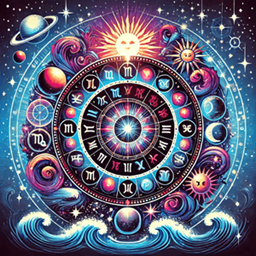
This lesson explores the philosophical and symbolic foundations of astrology, showing how it serves as a bridge between the cosmos and human consciousness. Students learn that astrology is not about fate, but about understanding potential and patterns. Through the Hermetic axiom “As above, so below,” it reveals how celestial movements reflect life on Earth. By distinguishing astrology from astronomy and viewing it as a symbolic language, learners begin to see the universe as a mirror of inner experience — an invitation to think, question, and interpret with wisdom rather than superstition.
🌌 The Philosophical and Symbolic Basis of Astrology
Astrology is far more than predicting events or categorizing personalities. Rather, it is a symbolic system that mirrors the relationship between the cosmos and human consciousness. When approached philosophically, astrology becomes a language of meaning — one that invites reflection about life’s deeper patterns and purposes.
🌠 What Does Astrology Explain?
Many students begin by asking, “Does astrology explain fate, personality, or potential?” The answer depends on how you view the cosmos. Astrology does not force outcomes; instead, it reveals tendencies, potentials, and inner dynamics. In this sense, the birth chart functions like a map — not a mandate. It shows the landscape of your psyche, but how you travel that terrain remains your choice. Therefore, astrology becomes a tool for self-awareness rather than fatalism.
🜂 The Origins and Purpose of Astrology
From ancient Babylon to Hellenistic Alexandria, astrologers observed that celestial movements often coincided with earthly events. Over time, these observations gave rise to symbolic associations between planets and life experiences. The purpose of astrology, then, was not merely to predict the future, but to understand the rhythm of existence itself. As civilizations evolved, astrology helped people align with cosmic cycles — planting, building, or making decisions when the heavens seemed favorable. Consequently, it served as both a practical and spiritual guide.
🜄 Astrology as a Symbolic Language
Unlike mathematics or physics, astrology speaks through symbols rather than equations. Each planet, sign, and house represents an archetype — a universal pattern of human experience. For example, Mars symbolizes action, drive, and courage, while Venus embodies love, beauty, and harmony. When you interpret a chart, you are reading a cosmic poem rather than a technical manual. This poetic language connects the outer sky with inner emotion, allowing intuition and intellect to work together.
🌍 Astronomy and Astrology: Science and Symbolism
Although astronomy and astrology share a common ancestry, they now serve different purposes. Astronomy studies celestial bodies as physical objects governed by natural laws. Astrology, however, interprets those same bodies as symbols of consciousness and meaning. Both disciplines require observation and precision. Yet, astrology adds a reflective dimension — it asks “What does this movement mean for human life?” In this way, astrology complements rather than competes with science.
✶ The Hermetic Axiom: “As Above, So Below”
The ancient Hermetic principle, “As above, so below,” expresses the core idea behind astrology. It suggests that patterns in the heavens correspond to patterns on Earth. Just as the tides follow the Moon, so too our inner tides respond to cosmic rhythms. This is not a matter of physical causation, but of symbolic resonance. When the outer world reflects the inner, we begin to see the universe as a living mirror. As a result, astrology becomes a path of integration — uniting the human and the divine within a single cosmic order.
🌞 Reflection and Dialogue
So, how might celestial patterns mirror the patterns of your own life? What do your personal rhythms reveal about your growth, choices, and destiny? By asking these questions, you begin to think like an astrologer — one who seeks understanding, not certainty.
In the end, astrology’s value lies not in prediction, but in participation. It invites you to engage consciously with the universe, to see meaning where others see only motion, and to remember that every planet, like every person, plays a part in the grand symphony of existence.